
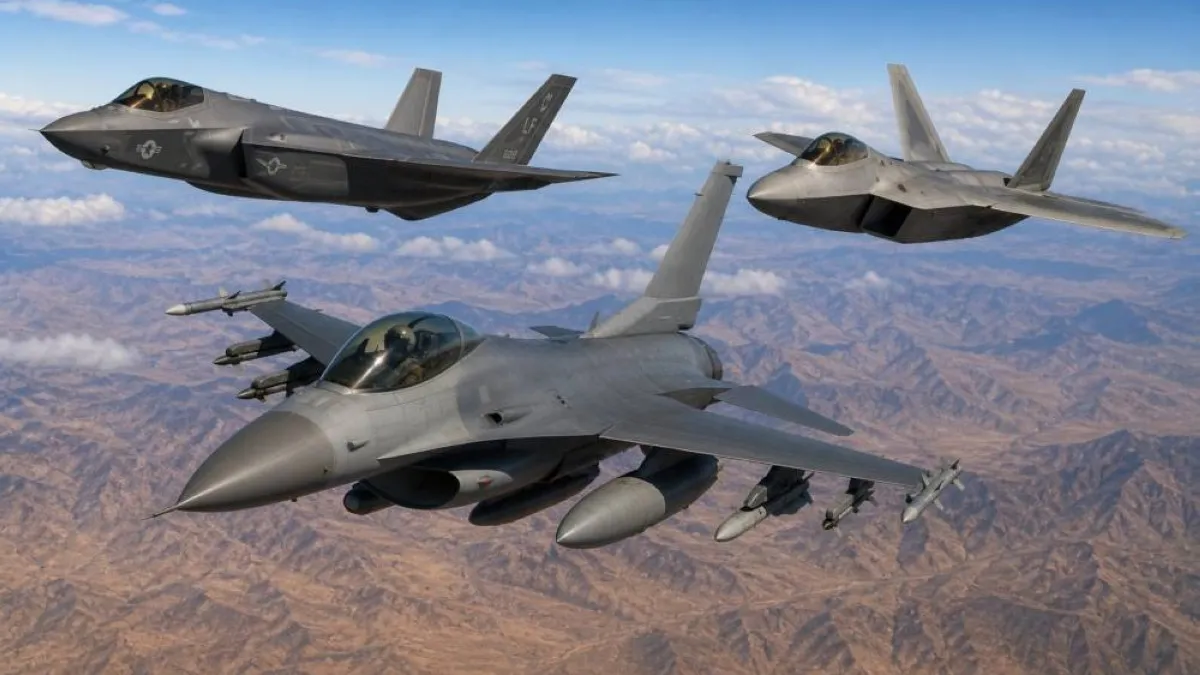
US Air Force Continues to Rely on F-16 Fighter Jet Despite Advanced Aircraft
📋 Key Takeaway: The F-16 Fighting Falcon remains the most utilized aircraft in the US Air Force, demonstrating remarkable combat efficiency and versatility since its introduction in 1979.
F-16’s Enduring Role in the US Air Force
Despite the advanced capabilities of fifth-generation fighters like the F-35 Lightning II and F-22 Raptor, the F-16 Fighting Falcon continues to be the backbone of the US Air Force’s aerial operations. Entering service in 1979, the F-16 has proven its effectiveness in a variety of roles, including air-to-air combat, ground attack, and close air support. Its versatility and reliability have made it one of the most trusted aircraft in the history of the US military.
Data indicates that the F-16 boasts an impressive kill ratio of 76 to 1 across its various versions, having successfully engaged 76 aerial targets while losing only one aircraft. This operational superiority underscores the F-16’s effectiveness in diverse combat environments, contributing to its continued prominence in military operations.
Production and Technological Advancements
The US Air Force operates approximately 840 F-16s in various configurations, a fleet size that surpasses the total air forces of many countries. Since its inception, over 4,550 units have been produced, with the aircraft serving not only the United States but also 28 allied nations, some of which have obtained licenses for local production. Manufactured by Lockheed Martin in South Carolina, the F-16 has undergone numerous upgrades to enhance its combat capabilities over the years.
The latest variant, the F-16V Block 70/72, incorporates advanced technologies, including the APG-83 AESA radar developed by Northrop Grumman, which significantly improves target detection and tracking in various combat conditions. The aircraft is powered by either a Pratt & Whitney F100-PW-229 or a General Electric F110-GE-129 engine, enabling it to reach speeds of up to Mach 2, approximately 1,535 miles per hour, with a combat radius of around 2,002 miles.
Future Prospects and Operational Significance
The F-16’s extensive armament capabilities, which include air-to-air missiles, anti-ship missiles, precision-guided bombs, and a 20mm M61A1 Vulcan cannon, make it a highly versatile combat platform. Its operational cost-effectiveness compared to newer fighters contributes to its sustained relevance within the US Air Force, where it continues to play a pivotal role in global air operations.
Looking ahead, the F-16 is expected to remain in service for several more years as part of ongoing modernization efforts, which will integrate advanced electronics and weapon systems. This enhancement will enable the F-16 to operate alongside modern fighters like the F-35, ensuring its continued effectiveness in both defensive and offensive missions.
Frequently Asked Questions
What is the F-16 Fighting Falcon?
The F-16 is a multi-role fighter jet used by the US Air Force, known for its versatility and combat efficiency.
How many F-16s are currently in service with the US Air Force?
The US Air Force operates approximately 840 F-16s in various configurations.
What are the key features of the F-16V variant?
The F-16V variant features advanced radar, improved avionics, and enhanced combat capabilities.
Why does the US Air Force continue to use the F-16?
The F-16 is cost-effective, versatile, and has a proven combat record, making it a reliable choice for various missions.