Researchers Discover Homeric Text in Egyptian Mummy, Revealing Unique Burial Practices
📋 Key Takeaway: In a groundbreaking discovery, researchers have found a fragment of Homer’s Iliad in a 1,600-year-old Egyptian mummy, highlighting unusual burial practices in Roman-era Egypt.
Significant Discovery in Egyptian Archaeology
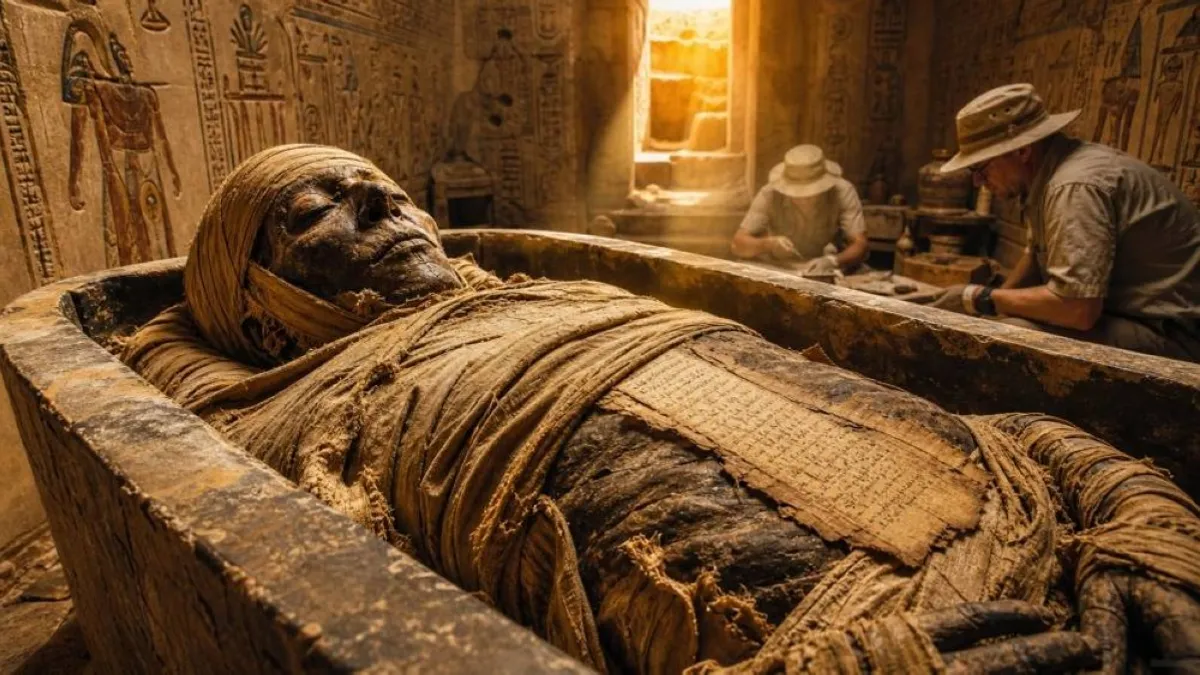
In a world-first discovery, researchers have uncovered a fragment of the Iliad, attributed to the ancient Greek poet Homer, within a 1,600-year-old Egyptian mummy. This finding was made during excavations at the Bahnasah site in Minya Governorate, a significant historical center during the Greek and Roman periods in Egypt. The fragment was found placed on the chest of the mummy as part of burial rituals, indicating a unique use of literary texts in embalming practices of the time.
The discovery was made by the Oxyrhynchus archaeological mission, part of the Institute of Ancient Near Eastern Studies at the University of Barcelona, led by researchers Maite Mascort and Esther Pons. The papyrus is estimated to date back approximately 1,600 years, making it the earliest known example of a Greek literary text used in a funerary context, contrasting with the typical religious texts that were commonly employed in such instances.
The excavation took place between November and December 2025, under the direction of Nuria Castellano, who led the team in Sector 22, Grave 65, where the mummy and papyrus were discovered. Although previous finds of Greek papyri in mummies have occurred at this site, they have typically involved ritual texts or spells, making this finding particularly exceptional.
Details of the Papyrus Fragment
Analyses of the papyrus revealed it contains a portion of the ‘Catalogue of Ships,’ a famous section from Book II of the Iliad, which lists the Greek forces involved in the Trojan War. This excerpt is considered one of the most significant literary and historical passages of the epic. Subsequent studies conducted between January and February 2026 involved a team of experts, including Margalida Monar, Leah Masia, and Professor Ignacio-Javier Diego, who confirmed the text’s identification through meticulous reading.
Diego, the director of the Oxyrhynchus project, emphasized that the identification of the text was based on precise readings that validated its connection to this well-known segment of the Iliad. This discovery not only highlights the literary significance of the text but also opens new avenues for understanding burial practices in Roman-era Egypt.
Cultural and Scientific Significance
Researchers noted that this finding provides new insights into funerary practices in Egypt during the Roman period, indicating a notable shift from the traditional use of magical texts to the inclusion of classical literary works in embalming rituals. Diego remarked on the unique nature of finding a literary text in a burial context, as the Oxyrhynchus site has yielded thousands of papyri since the late 19th century, including important Greek literary texts, but this case represents a scientific first.
The Bahnasah site, located approximately 190 kilometers south of Cairo near the Nile branch known as Bahr Youssef, has revealed a funerary complex consisting of three limestone-built chambers containing Roman-era mummies and intricately decorated wooden coffins, many of which have suffered damage from past looting.
Ongoing Archaeological Efforts
The Oxyrhynchus mission, one of the longest-running Spanish archaeological projects in Egypt, has been active since 1992 under the leadership of Professor Josep Padró. The latest campaign, conducted from November 2025 to February 2026, has yielded discoveries deemed of major historical and archaeological significance. The project is supported by various institutions, including the Spanish Ministry of Culture, the University of Barcelona, the Palarq Foundation, and the Catalan Society of Egyptology, in collaboration with Egypt’s Supreme Council of Antiquities and Cairo University.
This discovery underscores the cultural interplay in Egypt during the Roman period, where ancient Egyptian traditions merged with Greek influences, reflecting the value of classical literary texts even in unconventional contexts such as burial rituals.
Frequently Asked Questions
What was discovered in the Egyptian mummy?
A fragment of Homer’s Iliad was found, marking a unique use of literary text in burial practices.
Who led the excavation team that made the discovery?
The excavation was led by researchers from the University of Barcelona’s Oxyrhynchus archaeological mission.
What does the discovery indicate about Roman-era burial practices?
It suggests a shift from traditional magical texts to the inclusion of classical literary works in funerary rituals.
Where was the mummy and papyrus found?
They were found at the Bahnasah site in Minya Governorate, Egypt.
What is the significance of the ‘Catalogue of Ships’ in the Iliad?
It lists the Greek forces involved in the Trojan War and is a crucial literary and historical passage.