Etihad Rail Reports Significant Growth in Freight Sector for 2026
📋 Key Takeaway: Etihad Rail has reported notable growth in its freight sector for 2026, transporting 1.8 million tons of sulfur and enhancing operational efficiency.
Freight Operations Surge in 2026
Etihad Rail has announced a remarkable increase in its freight operations for the year 2026, with the company transporting 1.8 million tons of sulfur, over 4 million tons of rocks and gravel, and more than 129,000 containers. This marks a significant improvement compared to the 148,000 containers transported in 2025, highlighting the company’s ability to sustain growth and enhance operational efficiency.
Aldhraa Al Mansouri, Director of Public Policy and Sustainability at Etihad Rail, emphasized that the company’s freight services have successfully supported sustainability targets by eliminating over 340,000 truck trips on roads and reducing carbon emissions by 70% to 80% per journey. The railway freight solutions are positioned as a comprehensive, cost-effective, and reliable operational alternative available throughout the UAE.
The rail freight services are directly connected to Khalifa Port, Jebel Ali Port, and the Abu Dhabi Industrial City (ICAD), along with major logistics centers across the nation through 11 stations, including four primary ports. Each freight train is capable of transporting the equivalent of 300 heavy trucks, thus enhancing the capacity for transporting large quantities of goods in a single trip.
Client Partnerships and Operational Efficiency
Al Mansouri noted that the current client list includes prominent companies such as ADNOC for sulfur transport, Stevin Rock for aggregates, and Borouge for petrochemicals. The freight trains operate on dedicated schedules and routes, ensuring uninterrupted operations free from traffic congestion or road accidents.
Since the launch of freight operations in February 2023, Etihad Rail’s freight division has experienced continuous growth, significantly contributing to trade movement and supply chain efficiency in line with the expanding industrial sector’s demands. The company is committed to providing reliable and sustainable freight services.
Future Developments in Passenger Services
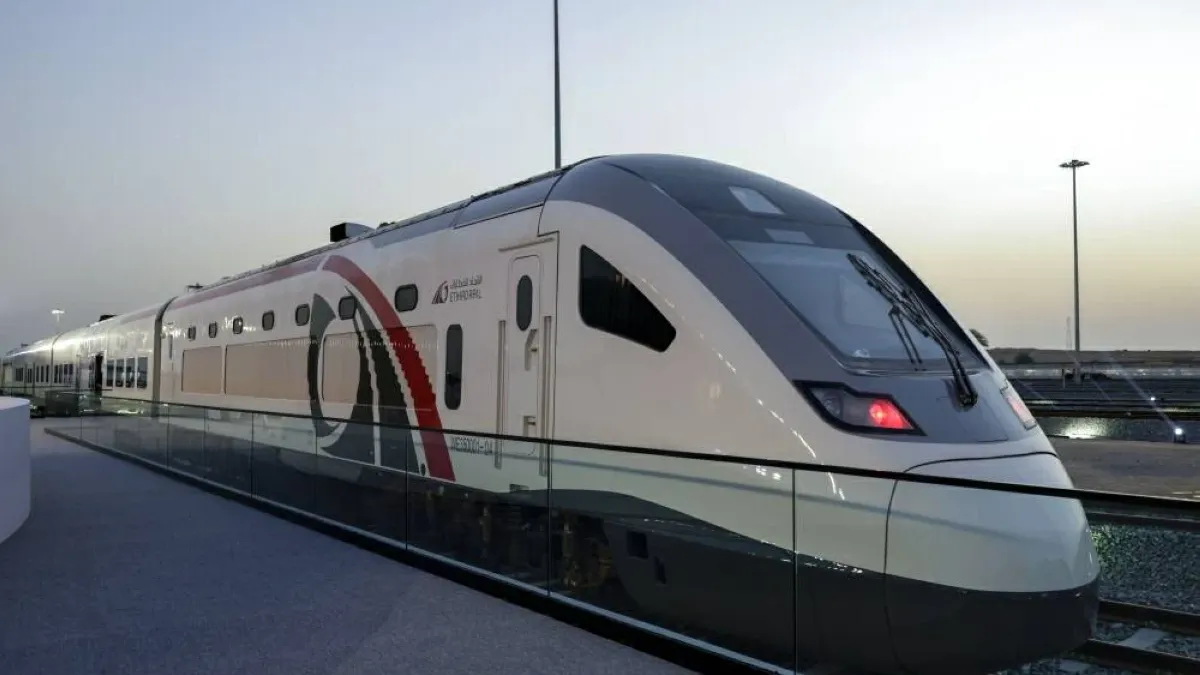
Regarding passenger transport services, Al Mansouri explained that operations will be rolled out in a phased and calculated manner, with the first phase set to commence in 2026. This rollout aims to adhere to the highest standards of safety, reliability, and efficiency, aligning with global best practices in railway network operations.
The initial operational phase will connect Abu Dhabi to Dubai, extending to Fujairah on the eastern coast. The selection of the initial routes was based on criteria such as population density, demand volume, and priority connections between the emirates.
Commitment to Local Industry and Sustainability
Al Mansouri highlighted Etihad Rail’s participation in the ‘Make it in the Emirates 2026’ platform for the second consecutive year, underscoring the event’s significance in supporting industrial growth, investment, and transformative technologies to bolster the UAE’s economic growth.
She emphasized that the Etihad Rail network represents a comprehensive national model embodying the ‘Make it in the Emirates’ initiative. Approximately 70% of the construction materials used in the development and operation of the network have been sourced from local companies, with local suppliers constituting 97% of the total suppliers engaged with the company, reinforcing the commitment to supporting national industries and confidence in Emirati capabilities.
Etihad Rail remains dedicated to advancing national infrastructure that promotes sustainable mobility, benefiting the community and future generations through projects that include both passenger and freight trains within the UAE’s national railway network.
Frequently Asked Questions
What are the key achievements of Etihad Rail in 2026?
Etihad Rail transported 1.8 million tons of sulfur and over 4 million tons of rocks and gravel, significantly increasing its freight capacity.
How does Etihad Rail contribute to sustainability?
The company has reduced carbon emissions by 70-80% per freight journey and eliminated over 340,000 truck trips.
When will passenger services begin on Etihad Rail?
The first phase of passenger services is expected to commence in 2026, connecting Abu Dhabi to Dubai and Fujairah.
What percentage of materials for Etihad Rail are sourced locally?
Approximately 70% of the construction materials used for the network have been sourced from local companies.
How does Etihad Rail support the UAE’s economy?
Etihad Rail enhances trade movement and supply chain efficiency, contributing to the growth of the industrial sector.