Shenzhen University Reveals New Coal Battery Technology Aiming to Reduce Emissions
📋 Key Takeaway: A recent study from Shenzhen University proposes a novel coal battery technology that converts coal into electricity without combustion, potentially reducing emissions significantly.
Innovative Approach to Coal Energy Generation
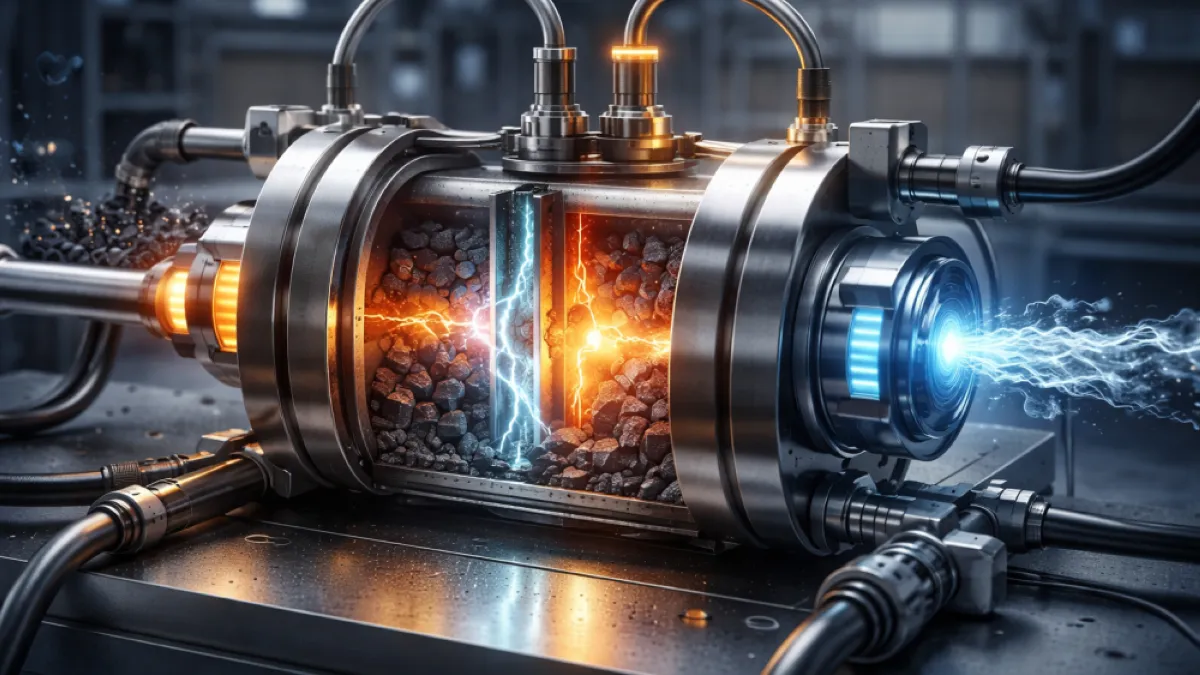
A groundbreaking study from Shenzhen University in China has introduced a new technology known as the ‘coal battery’ or direct coal fuel cell. This innovative method aims to redefine the utilization of one of the world’s most polluting energy sources by converting coal’s chemical energy directly into electrical current within a closed electrochemical cell, eliminating the need for traditional combustion.
The process begins with the conversion of coal into an ultra-fine powder, which is then purified to remove impurities such as sulfur and ash. This finely processed coal is placed at the positive electrode of the cell, while oxygen is pumped into the negative electrode. Through this system, chemical reactions occur that extract electrons from the carbon in coal, allowing these electrons to flow through an external circuit to generate usable electricity.
One of the primary advantages of this technology is that it produces electricity without the conventional thermal combustion phase. This means there is no need to first convert energy into heat, then into steam, and finally into mechanical movement in turbines, a process that typically results in significant energy loss. The theoretical efficiency of the coal battery thus presents a compelling case for its potential.
Emission Control and Technological Challenges
A notable aspect of this system is its ability to contain emissions rather than releasing them into the atmosphere. Unlike traditional coal power plants that emit carbon dioxide and other pollutants widely, this cell produces carbon dioxide in a more concentrated form, theoretically enabling its capture, processing, or storage. This gas could be directed towards carbon capture technologies or transformed into stable solid materials, or even reused in various chemical industries.
Despite the promising outlook, the technology remains in the research and laboratory testing phases and has not yet reached commercial viability or the construction of actual power plants. Several technical challenges hinder progress, including the requirement for extremely high temperatures ranging from approximately 1100 to 1650 degrees Fahrenheit, and material corrosion issues due to harsh chemical conditions.
Moreover, coal cannot be used directly; it requires complex processing that includes grinding it into particles as small as 10 microns and removing ash, heavy metals, and impurities that could impact reaction efficiency or disrupt the system. These preparatory processes consume additional energy, potentially diminishing some of the anticipated benefits.
Future Prospects and Industrial Scalability
Research indicates that while theoretical performance may be high, actual efficiency drops significantly when accounting for energy consumption in auxiliary systems such as cooling, pumping, and thermal control, with estimates suggesting a real-world efficiency of only 55% to 60% in optimal conditions. Additionally, scaling this technology for industrial use poses substantial challenges, as operating thousands of cells simultaneously requires precise systems for coal distribution, ash removal, and blockage prevention, alongside the need for durable materials capable of sustained operation.
Nonetheless, researchers believe this technology could pave the way for a new approach to coal usage, particularly in countries like China, where coal remains a significant source of electricity generation. Future concepts include deploying these cells directly within mines, potentially reducing transportation costs and allowing for carbon processing at the source.
Frequently Asked Questions
What is the coal battery technology?
It is a new method that converts coal’s chemical energy directly into electricity without combustion.
How does the coal battery reduce emissions?
It contains emissions by producing carbon dioxide in a concentrated form, making it easier to capture and process.
What are the main challenges facing coal battery technology?
Key challenges include high operational temperatures, material corrosion, and the complex processing of coal.
Is the coal battery technology commercially available?
No, it is still in the research and laboratory testing phases.
Could this technology impact coal usage in countries like China?
Yes, it could redefine coal usage, especially in countries heavily reliant on coal for electricity.