
Dwarf Planet Haumea to Block Star Light in Rare Celestial Event
📋 Key Takeaway: On Monday evening, the dwarf planet Haumea will pass in front of a distant star, creating a stellar occultation visible across the Arab world.
Stellar Occultation Details
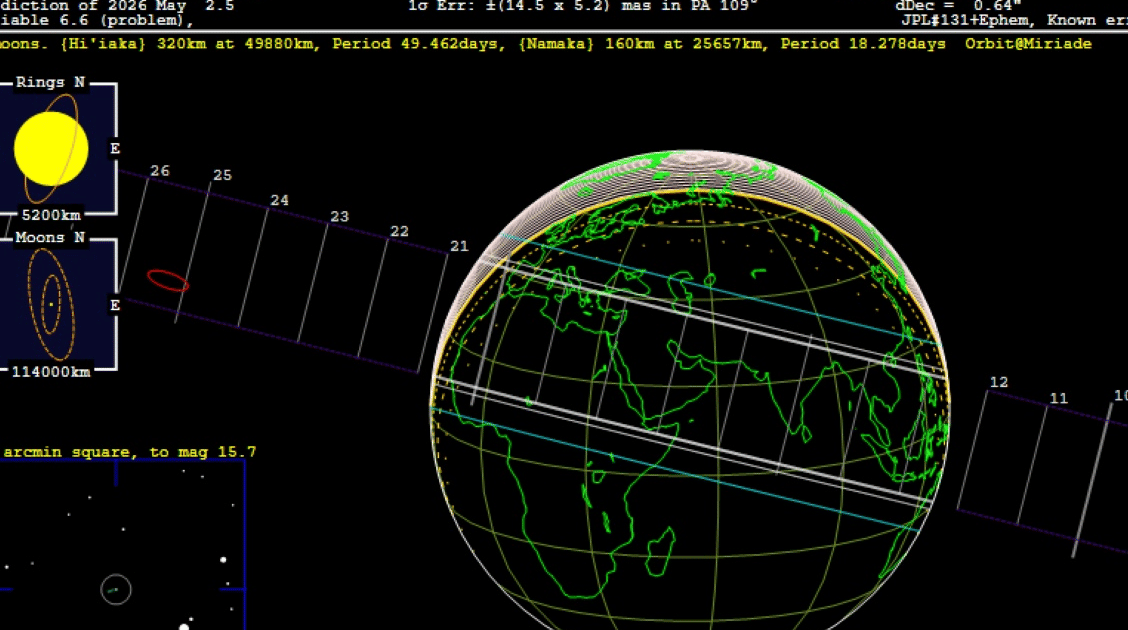
A rare astronomical event is scheduled for Monday evening, as the dwarf planet Haumea will pass directly in front of a distant star, momentarily blocking its light in a phenomenon known as a stellar occultation. The International Astronomical Center has indicated that this event could last up to 119 seconds, providing a unique opportunity for observation across much of the Arab world.
The occultation will commence in the eastern regions of the area, starting in Oman and the United Arab Emirates at 20:16 GMT. This will be followed by Jordan at 20:17, Egypt at 20:18, and Morocco at 20:20. Observers situated along the central path of the event can expect the phenomenon to last between 80 and 88 seconds.
Scientific Significance of Haumea
Haumea is classified as a dwarf planet, a celestial body that is larger than an asteroid but smaller than a full-fledged planet. Currently, the solar system is recognized to have five dwarf planets: Pluto, Ceres, Eris, Makemake, and Haumea. Haumea, along with Makemake and Pluto, resides within the Kuiper Belt beyond Neptune, while Ceres is found in the asteroid belt situated between Mars and Jupiter. Eris orbits even farther out at the solar system’s outer edges.
What sets Haumea apart from other celestial bodies is its unique characteristics, including two moons and a ring system, which enhance the scientific relevance of the upcoming occultation event. As Haumea progresses in its orbit around the Sun, it will obscure a faint star with a brightness of magnitude 14.7. During this event, only Haumea, which shines at magnitude 17.3, will remain visible, leading to a measurable drop in brightness of approximately 2.7 magnitudes.
Visibility Across the Arab World
The stellar occultation will be observable from most Arab nations, providing an exciting opportunity for both amateur and professional astronomers. However, it will not be visible in Somalia, Djibouti, and the Comoros, limiting the event’s reach. The coordinated international observation campaign, which includes various observatories and research institutions, aims to maximize the scientific data collected during this rare occurrence.
Frequently Asked Questions
What is a stellar occultation?
A stellar occultation occurs when a celestial body passes in front of a distant star, blocking its light.
When will the Haumea occultation occur?
The occultation will begin on Monday evening, starting at 20:16 GMT in Oman and the UAE.
Where can I observe the Haumea event?
The event will be visible from most Arab countries, excluding Somalia, Djibouti, and the Comoros.
What makes Haumea unique?
Haumea is distinctive due to its two moons and ring system, alongside its classification as a dwarf planet.
How long will the occultation last?
The occultation could last up to 119 seconds, depending on the observer’s location.